To replenish my freezer with a yearly supply of non-processed, clean, organic meat, I choose to hunt for it. You either have to do it yourself or have someone do it for you, but in the end, if you eat holistic meat or any meat, the animal dies for your appetite. Most folks eat their cheese burger oblivious to the industries that artificially fatten and kills their food for them. The hunter lives with that intimate responsibility. Nonetheless, there are visceral gifts hunters receive for that ownership. What follows are the first three hours of my morning hunt.
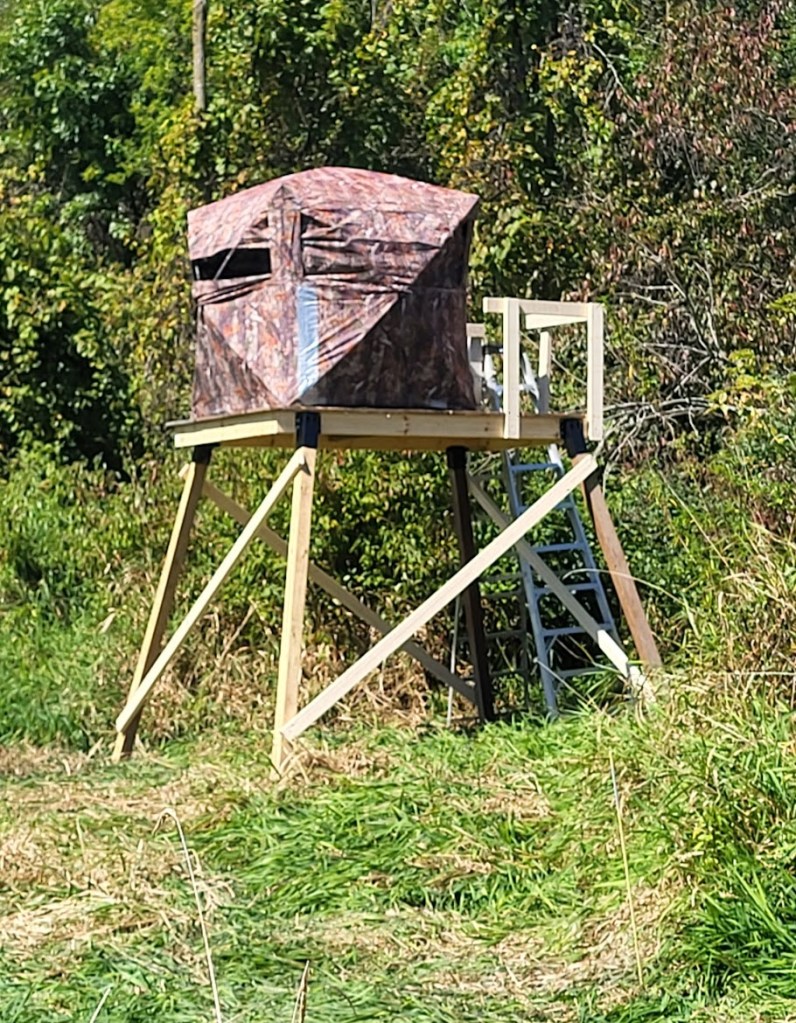
It begins with the stroll through the morning chill to the stand, a raised ten-foot platform I built with a 6X6X6-foot see-through cloth cube my friends from Down Under call a hide. I have a comfortable swivel chair with a shooting rail to steady my crossbow. I use a red headlamp that saves your night vision. In every submarine movie, red light is used before they surface at night so the crew can see immediately upon surfacing. It’s the same principle. Each season, however, I have to get use to the black demons darting past my peripheral vision. A characteristic of the singular light source on your forehead casting moving shadows. Nothing is hunting you in the woods of Central Wisconsin, but I jump in surprise every year.
The goal is to be settled into the stand, ready and quiet, an hour before first light. That time in the dark is used to assimilate. You listen and slowly join the rhythm of your surroundings, a process I covet.
Most mornings are windless. In our busy worlds, silence takes time to recognize and appreciate. Those first few minutes are a portal as your senses expand outward like the rings in a quiet lake after you toss a pebble. You hear owls in the distance. When the wind comes up, you record the leaves flittering in the branches and your brain will memorize their location. If squirrels or chipmunks are present they sound like a deer walking in the leaves. You curse them and take note. Now, having understood the notes of the natural symphony, you listen for the anomalies: a hoof scraping through the leaves, the crack of a stick, or the hum of an animal moving through the grass. Any of which will produce an adrenalin rush.
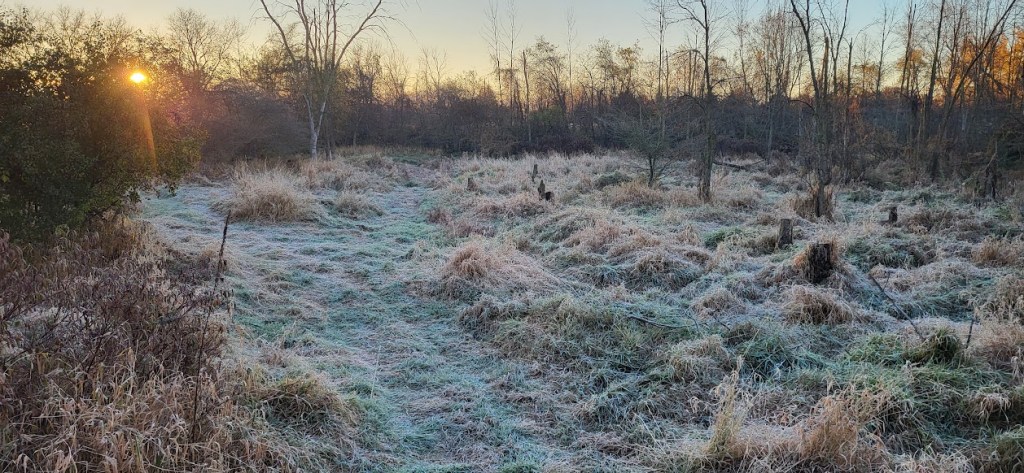
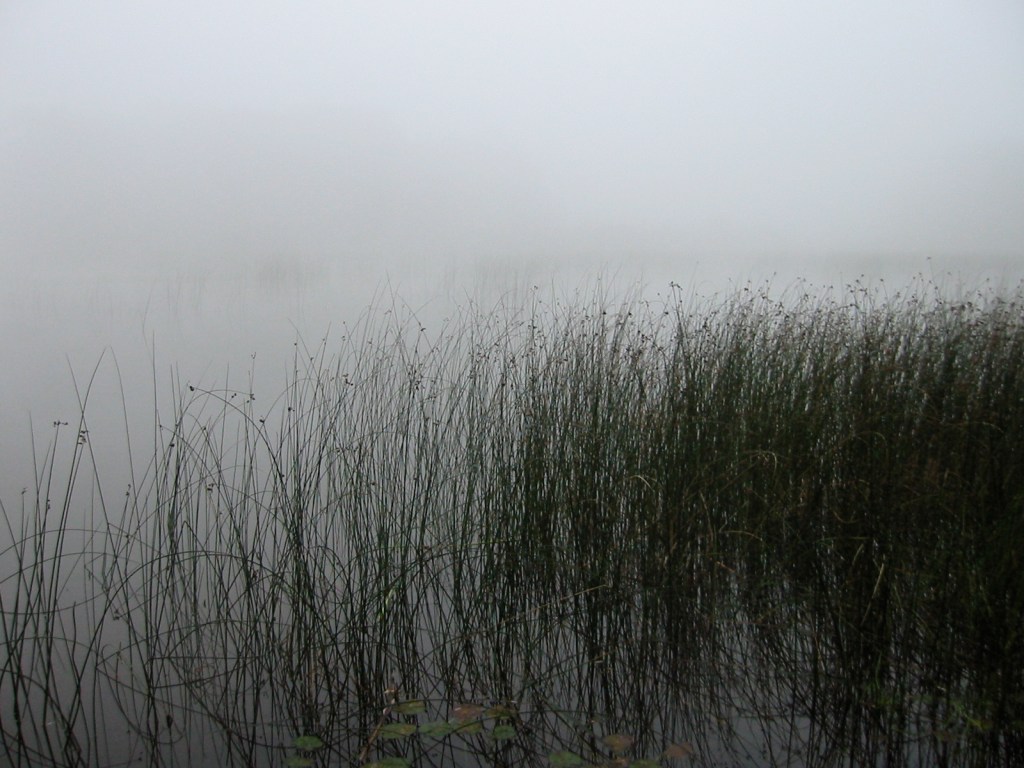
Today the woods, the marsh, and my stand are covered in frost. Lucky me, the deer walking through the waist high foliage will sound like a zipper. As the light comes up, the marsh carries the subtle undulations of a gigantic bowl of oatmeal. The layers of temperature creating what looks like steam. Birds begin to chirp and the early silence become a cornucopia of life.
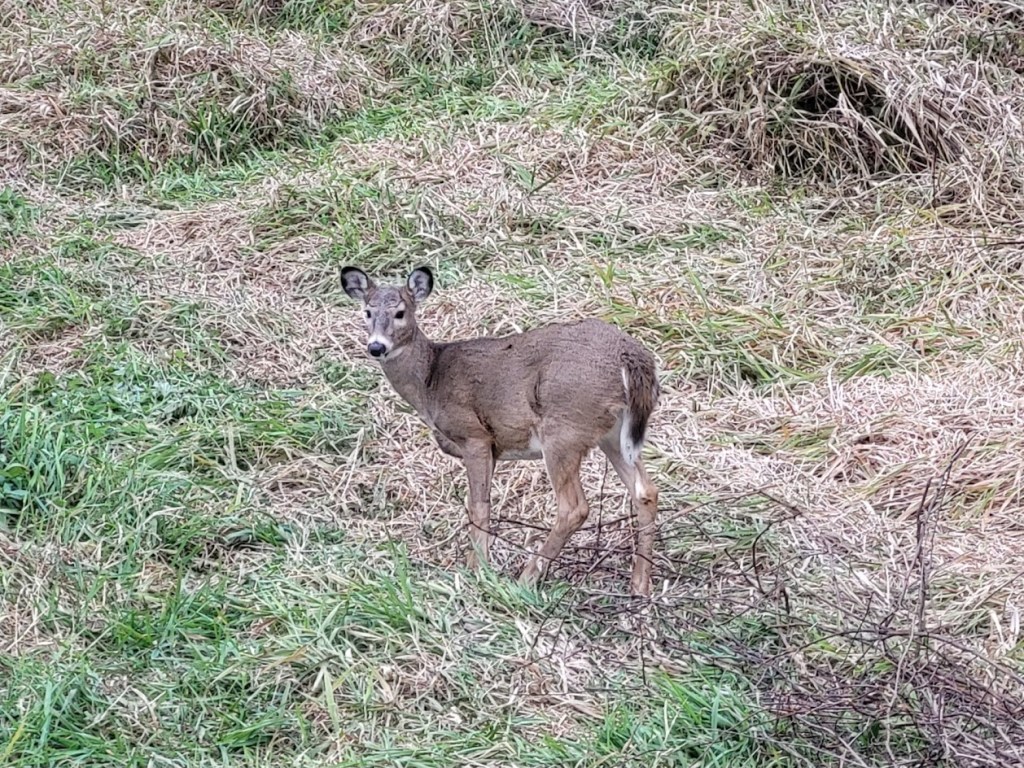
This time of the season is the buck rut. The boys are chasing the girls. Seventy yards from my perch is an area deer will bed down for the night. Hence, my early arrival and silence. Suddenly, a stampede erupts with five doe scattering in multiple directions. In the middle of the melee, stands a six-point buck who had surprised the ladies jerking his head around deciding which doe to chase. The buck is my goal. I’m hunting at home. I see the doe all year long. They frolic around the house in the summer, their like pets. The buck makes his decision and lopes across the marsh through the grass and fallen ash trees. An easy shot with a rifle, but impossible with a crossbow. Gun season is still two weeks away.
There is no disappointment. Hunting requires patients. Other opportunities will be forthcoming. I’ve just witnessed a wonderful moment in nature. Something you have to be in the woods to appreciate. Perhaps I’ll see him later. Last year, a doe came into view 20 yards away closely follow by an 8-point buck. He was part of my dinner last night as I watched Game Six of the World Series.
With the dawn excitement passed, the sun tossed a warm blanket over my blind. The frost had coated both sides of my camouflaged cocoon. In moments, it began precipitating in my hide. Rain was twinkling down on me from the interior roof. That’s a first, as I chuckled at another unexpected visceral gift. I take note to pack a towel with my gear as a drop finds the back of my neck. It’s another fine story for the next campfire.
Our cabin near Pardeeville, WI has forever been a sanctuary. Sixty acres hugging half of Columbia County’s Crystal Lake shoreline. Town folk have two additional names for the thirty-two-acre jewel, ‘One a Day Lake’ (coined for the difficulty of catching a legal bass [14 inches]) and ‘Abell Lake’ (The property owned and shared by our family for five generations since 1952.)
Waterfowl season populates the house with: chest waders, hip boots, shell boxes, shotguns, and the comradery, brotherhood, and laughs rendered by over five decades of our October gatherings.
After opening weekend, I take the opportunity to venture out by myself. My singular experience can hardly be construed as alone.
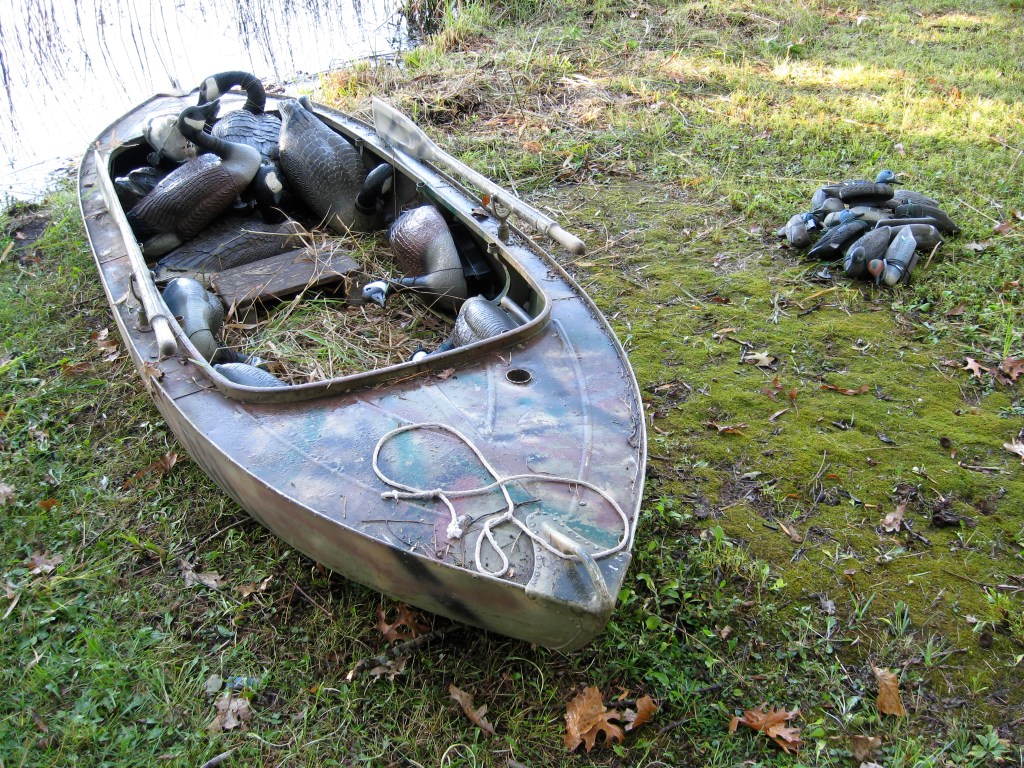
In pre-dawn, my motions are automatic. I flick off the outside lights, pull the door closed, turn on my headlamp, and stroll fifteen yards to our antique Aluma Craft Ducker Boat. This double bowed treasure is the Ferrari of our five row boat fleet. I recon my grandfather purchased this, but there’s nobody left to answer that question.
There are no traditional seats, I sit on a three-inch wooden ‘stool’, older than my seventy-four years, surrounded by Canada goose and Mallard decoys. The stars watch my transition from pier to boat, pleased that I remained dry. With two bows (Two pointed ends), I can pull or push the oars with ease. It’s a clear morning, but a ground fog, reminiscent of the Baskervilles, leaks from the marsh behind south shore. I push so I can see my destination and watch for the Hounds.
The moon is near full. My earworm becomes the Cat Stevens song about moon shadows, I pop a smile. The second brightest heavenly body is the planet Venus. Her dazzling twinkle simply in the sky to bring me luck.
As I approach the fog bank, I know what’s coming and accelerate. I ship the oars and glide through a collection of bull rushes, whip-like aquatic plants that stand above my head and part around the bow like walrus whiskers, curious and exploring. As I pass through them, their gentle caress creates a short symphony played only for my ears the notes change pitch on each bull rush plays the boat like a violin. I celebrate how lucky I am to experience this unique music. A singular moment in nature that brings presence. A song never to be performed the same again. Until the next mornings’ score is written.
I feel blessed and grateful. The sunrise is still to come.
One morning, Frank Mayer, our company’s Chairman of the Board, invaded my office and seized the chair across from my desk. As approachable as Frank was, he never dropped in like that. My surprise would transform to terror. As was his trademark, he got directly to the point, “I think you should write your experiences down from Mexico for publication in our company’s newsletter. Let everyone know it isn’t always all about business.” “I went to Art School, Frank. I never wrote anything in my life.” “It is a story that needs to be told, Ed”.
The company where I was a Designer, Project Team Leader and ultimately head of Creative Operations is called Frank Mayer & Associates, Inc. We had a strategic partner in Mexico City called APTO/FrankMayer.
In 2001 our President, Mike Mayer and I would attend a special ten-day business class at the Cuauhnahuac Language Institute in Cuernavaca, Mexico. Our goal was learning politeness and business etiquette to facilitate our Latin American client meetings and in my case, a little Spanish as well.
After our return, the stories of my exploits began to circulate around the company and to Frank’s ears. I was completely humbled by what happened and I didn’t want anyone to misunderstand this tale as a vehicle for self-promotion. My emotions ran from elation to deep sadness, but this nudge to write ultimately became a new creative outlet for me that I continue to cultivate to this day. That was how this story was born.
At the trip orientation, I knew straight away we would have the opportunity to visit an orphanage. It is an annual tradition with the Milwaukee Area Technical College (MATC) group we would be traveling with. I told the group leader I had clowning skills and asked about any potential cultural road blocks. Her face erupted with joy; she was ecstatic about having a payaso (clown) to entertain the children. Then, she dropped her voice an octave and said, “You will be a hero.” I laughed and said, “Hero? Clowns aren’t heroes; we just try to make people smile”. I didn’t hesitate to volunteer, but contemplating the idea of a first-time trip to an orphanage saw my resolve leak with trepidation. In a parade you are simply part of all the activities, but I would be the singular focus at the orphanage and she would be right about the role I would play in the lives of those children.
I started clowning with my wife, Kristin and Mrs. Jeager in Sheboygan’s 4th of July parades. Mrs. Jeager had been Kristin’s Girl Scout Leader and her children were our generation. She did fifty parades. Later, our clowning became something cool to do with our two sons. We did our own thing with our faces for a while. The images of our first attempt at characters were naïve, but heartfelt. Think Gene Simmons from the band Kiss. I roller skated the first few times so no one could get a good look at me. It wasn’t long before we decided to take a makeup class. Ultimately, we discovered Clown Camp in La Crosse, Wisconsin. There were thirty-three states and six foreign countries represented. We stayed for an entire week studying; parade technique, physical humor, props, discovering our personalities, and designing our faces.
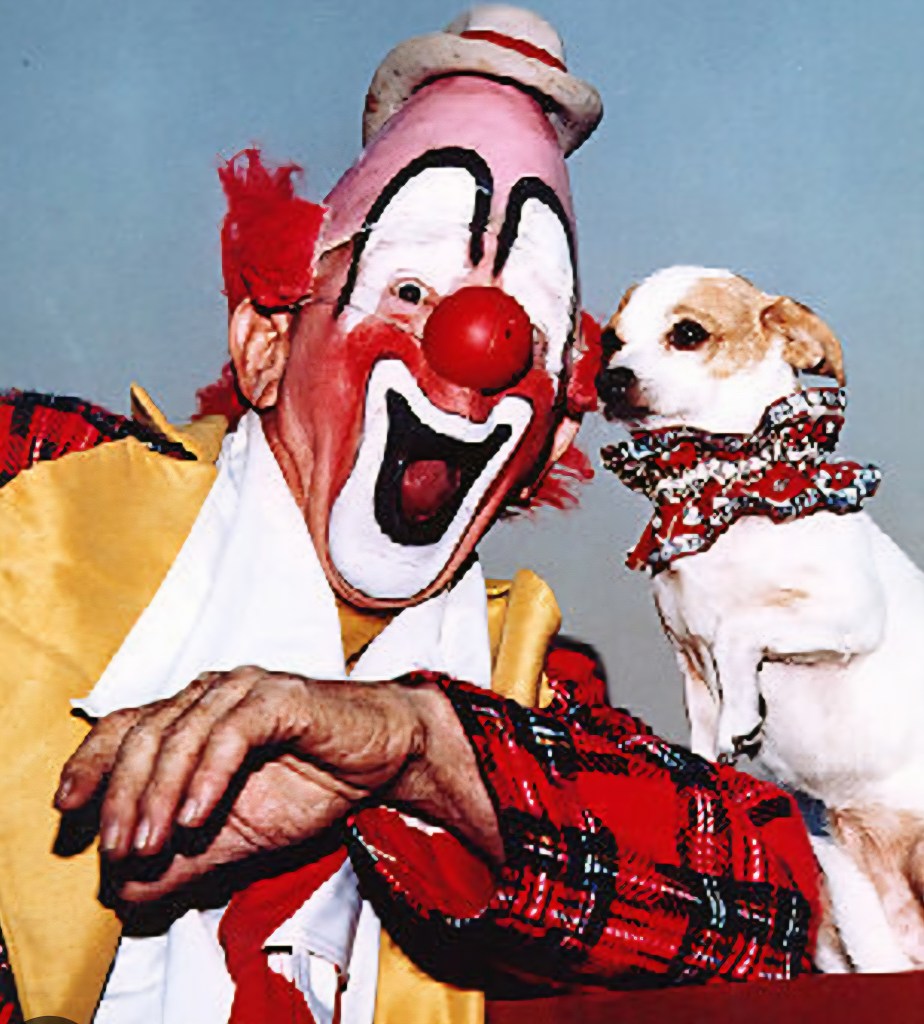
Lou Jacobs & Knucklehead
There were five Hall of Fame clowns included on the staff to teach classes and help with our faces. Jim Howle helped design mine. He had me come in with only half my face done, and he rendered the other side, a spectacular teaching method. Jackie LeClaire, who was the stunt double for Cornel Wilde in the Greatest Show on Earth, sort of adopted us. We were the first family to attend Clown Camp and he loved children. He shared wonderful stories about some of the great circus clowns from the hay-day of the Ringling Brothers. For Lou Jacobs, perhaps the most recognizable, he said, “Everything Lou did was BIG.” That statement resonated with me and became part of my performances.
Magic does happen when you make yourself available.
I have to say a few things about being a clown. Nobody can put on my big shoes and not smile. For me, something happens in the transition. I can’t tell what exactly, but the costume for me is a permission, an invitation to open your soul, a conduit to be spontaneous and create joy and happiness. Language, race and culture are not barriers. I’ve done things physically and expressively that are totally unplanned and difficult to explain or repeat. While in costume, even while going to and from a performance, I stay in character. You never know when a child may see you. I won’t take off my costume or come out of character until I’m at home. I consider my clown activity a hobby, but I take it seriously, it’s a big responsibility.
Cuauhnahuac Spanish Language Institute is perched along the flanks of a large tropical ravine. The administration buildings are across the upper edge with a pool. The student commons in the middle, and with the quaint cinder block classrooms covered by corrugated metal roofs across the lower reaches in an organized queue. The curriculum ranges from our ten-day program with language and cultural experiences available from six to twelve months of complete immersion into the language. I found the atmosphere totally relaxing until I went to classes. I had irregular verbs in the morning and conversation in the afternoon, just myself and the instructors. No other students to shield my ignorance. I hadn’t been in school for twenty-seven years. Horror comes to mind as I recall the instructor saying,” Eduardo, no ingles (English)”. But by week’s end, I could begin to converse in Spanish. The instructors were very patient with me and I can only imagine what I could have learned from an extended stay in such an enabling environment.
The orphanage
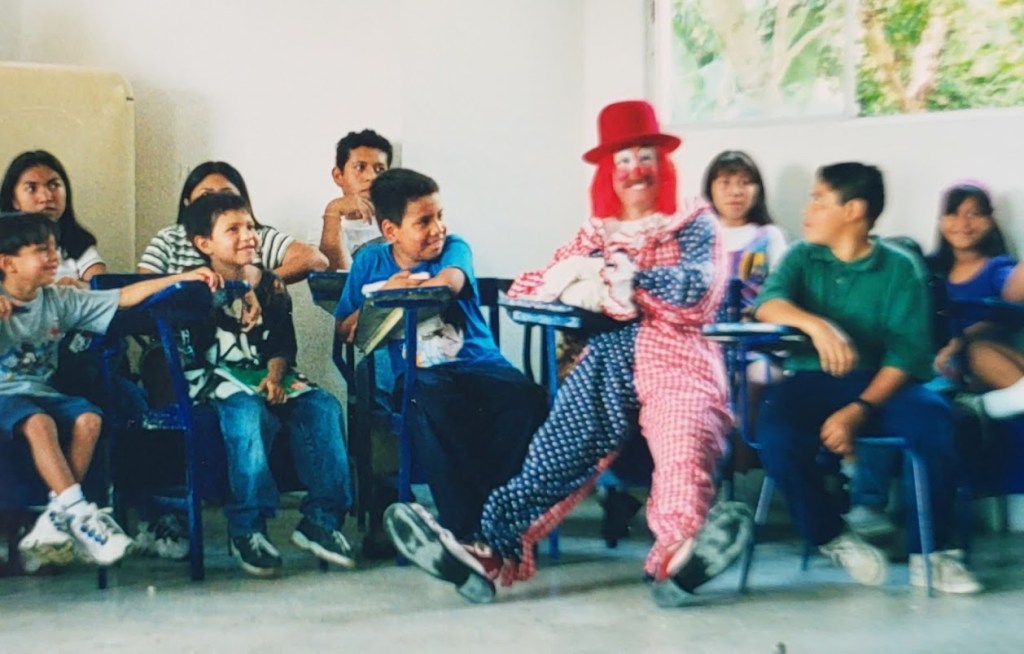
We had two busloads of people from our MATC group and the language school who wanted to spend time with the children. I was the only one with big shoes and orange hair, but everyone who participated brought a special day to the kids, all of them bringing valuable moments of human kindness.
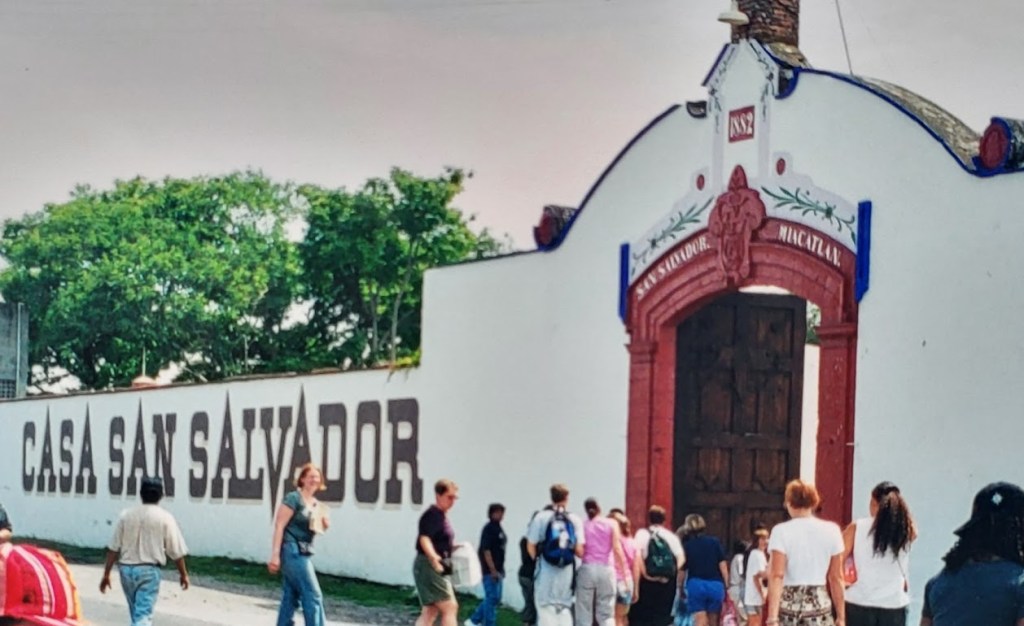
Casa San Salvador (House of Salvation) is a large walled complex. The wall is not to keep the children in, but to protect them from the outside. There were 350 kids living there. All of these children were abandoned somewhere along the line and were lucky enough to find their way to this sanctuary. All of the children stay there till they are eighteen years old. No children are adopted out so the family units stay together offering a social foundation. None of the children had seen a live clown before and for the younger ones, I would be their only focus. This is what I meant by big responsibility, I simply had to be present and open my soul.
It took me several minutes to get into the chair.
We saw three groups of kids, a total of about ninety. The first bunch were mixed ages between nine and fourteen. The younger ones collected the bulk of my camera stickers (an over-sized prop camera that produced ‘I met a clown today’ stickers) while our group spread out with the other kids and played basketball, drew with chalk on the playground or played games. Most teenagers on the planet will shy away from clowns. They occupy that zone between myths and reminisce and I’m cool with that. The energy in a crowd will tell me where to focus my attention.
The second group of kids we saw received the fifty-plus stuffed animals we had brought with us from the USA. Politics, red tape, and potential confiscation prevented us from shipping the soft toys directly to the orphanage so several of us volunteered to take an extra suitcase through customs. People coming into the country are checked at random. We wondered what to say to the customs agent about a suitcase full of stuffed animals, but I was prepared with a secret weapon and a Spanish response. Our partnership with APTO/Frank Mayer enabled me to meet Adrian Fernandez the famous Mexican race driver. I placed the photograph of Adrian and me on top of the stuffed animals in the suitcase. Thankfully, I was the only one pulled aside. When the customs agent saw the picture he said, “You know Adrian Fernandez?” and I said, “Si, es amigo mio.” (Yes, he’s a friend of mine.) He jerked his thumb and said, “Vamonos.” (Go.)
I’m told I looked like the Pied Piper.
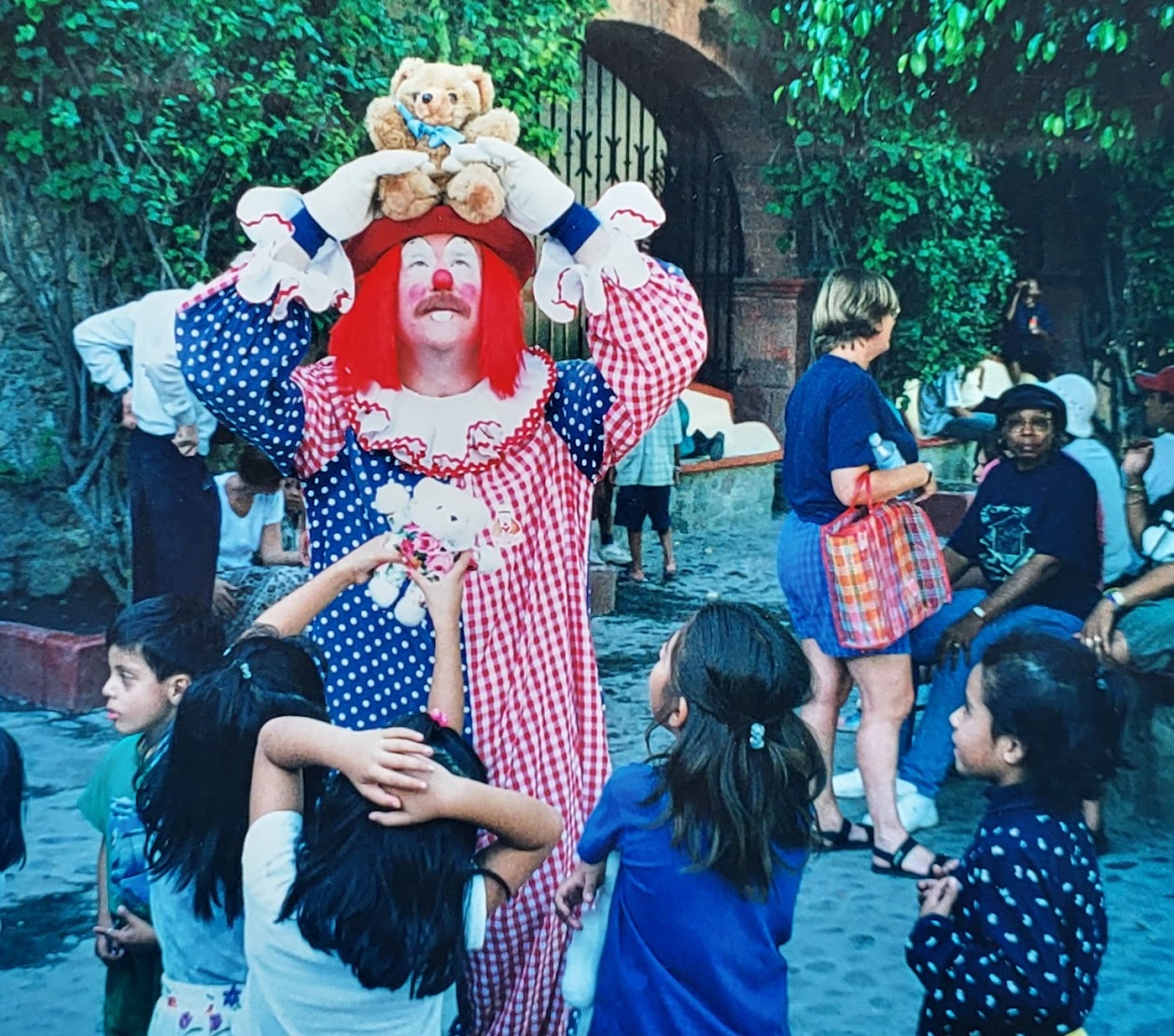
As we passed out the stuffed animals, I balanced one on top of my hat just to be silly. Once the kids saw that, they all ran up and wanted me to do the same for them. I didn’t stop until all the stuffed animals had been on my hat and yes, some of the kids came back for a second turn. It was great fun. Many just stared and smiled. It was enough for me to simply be present. I moved like a mother goose with all her goslings clinging to her like a bunch of grapes. It felt like ten minutes, but we had really been at the orphanage for over two hours so our time was coming to a close. I said goodbye to all my new friends and hugged as many as I could. As we all crossed the large courtyard I would turn and wave.
Suddenly, a young man ran up to me and said, “Please, senior, you must come back, there is one more group of children expecting to see the payaso and they have been waiting…” I could see the group of kids peering from around a corner about eighty yards away. They were the five and six-year-old’s. I looked at our group leader who had overheard the plea. I held up my hands gesturing my wish to return; she understood holding up ten fingers. I had a sudden unexpected rush of adrenaline, I jumped and spun around in a huge motion understanding in an instant that the kids could see me. I couldn’t just walk over there so I channeled Lou Jacobs. I began to leap across the courtyard in gigantic lopes. It felt like I’d left the ground by ten feet being carried by some numinous presence, I was Tigger. The kids saw me of course and emptied out from behind the building. They were yelling, “payaso, payaso” as they surrounded me. There must have been twenty kids.
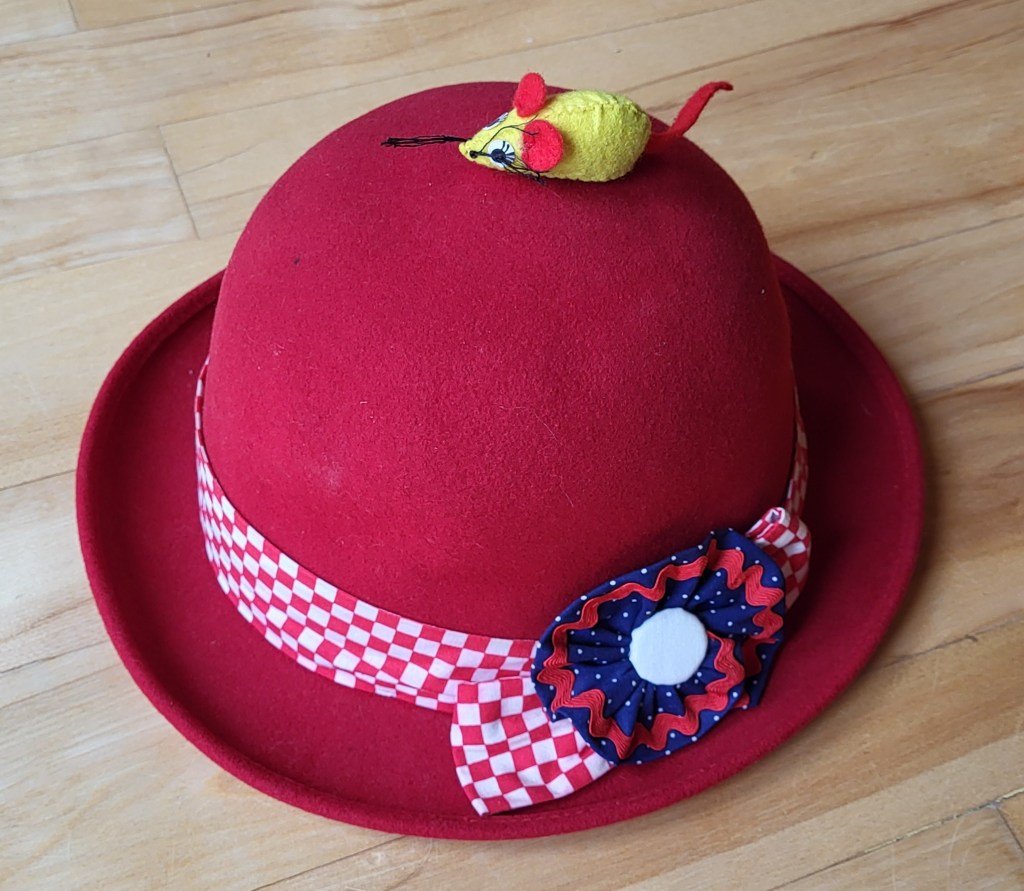
My clown name for this character was, Toofer. I had a yellow mouse on my hat. If a kid said, “That’s silly name.” I would say in a dopey clown voice, “See the little mouse? It rides up there cause it’s Too-fer to jump.” That always got laughs and groans. In clown lore, a groan is worth two laughs. It never failed. But in Spanish, the name didn’t translate so one of the administrators at the school gave me a new name.
There is a saying; The eyes of a clown are the windows to his soul. I was acutely conscious of that as I looked into the beautiful, inquisitive brown eyes all these children. They were like a bundle of brown fireflies. The only things these kids wanted to know was my name and if I was real. (Cual es su nombre? Es usted verdadero?) With swinging hand gestures and pointing at my nose, I bowed and said softly, “Mi nombre es Nariz Roja.” (My name is Red Nose.) I got down on one knee and they all gently touched my nose, hair, and hat and shook my hand with their faces beaming. I made sure I had eye contact and acknowledged each of them. The outpour of affection from these kids stunned me. Again, it was just about being present. They weren’t looking past the suit at the man; I was a real clown. The first one they had ever seen. In that moment clowning was no longer a hobby; it was a gift to these children that they will probably never forget. I did my best to be a good steward of the responsibility, but it was time again to say farewell, I did one of my silly clown walks backwards until they were out of sight.
I strolled back to the bus alone with my thoughts and feelings, proud to have been part of the MATC tradition with my fellow students and of the joy we brought to the children. As a clown, I wished I could have given even more to these kids who have so little. I was humbled by the divine assistance I received to perform as I did and quietly wondered if I was worthy. I was grateful that professionally applied makeup doesn’t come off with tears on it.
Imagine for a moment a homogeneous blue/white light. This illumination has an allure, enveloping and inviting. You feel a rightness, a belonging, and a connection as this radiating energy enfolds your being. You’re not cold or warm, just divine. As your sense of self is assimilated into a wonderful inclusion, you realize that this glow is not burning logs or a search beacon, but a numinous presence, your bliss, the bliss, it doesn’t matter. It’s a place from where everything originates and will ultimately return. There are no questions and no answers. Simply universal understanding and harmony. Nothing needs to be said. Be here now, here now be, now be here. The kingdom, the power, and the glory for ever and ever. You realize you are not only an individual part of this connection, you are at your core, one with this radiance. You are home, everything in balance, consciousness is reality. We are all one. Your learned sense of time dissolves into the eternal now.
That’s my vision of our life source. This numinous light is always present, but mostly unrecognized. However, we can see it represented in media, art, and religions. We all have an equal opportunity to access and be a conscious part of it. I don’t believe it’s a reward for good behavior in an afterlife. It’s not something for a special few, you simply have to make yourself available. We can all use it to be creators.
Of course, the ya-buts abound. Discussions, pontifications, arguments or edicts about what this numinous light is, continues to cause and validate much of the pain, strife, and war in the world. I’m not here to fix that or tell anybody what to believe. This is only my point of view rendered from my real life experiences.
In my mind, our individual lives track an elliptical orbit around that light and our nearness to the light can change with, and by, our life experiences, actions, dreams and supplications . I have lived through situations where the right individuals and or circumstances have shown up in my life when I absolutely needed them and dreams have come to fruition. I have felt numinous presence in natural settings and have been given physical power beyond my abilities while clowning and trekking around the world. To me, these are confirmations that I’m doing what the universe has in mind. Bliss moments like these, especially clowning, have left me humbled and unsure of my worthiness in receiving such a gift.
In some cases, even though I had visualized an outcome, the people that have manifested to assist me have had no idea they were doing angle business. Not just a wish mind you, you visualize and celebrate the outcome already completed. In other words, you pray believing. Angels and circumstances arrive in unexpected places and help to produce your outcome.
This conspicuous example took years to gestate.
Alcoholism shadowed my father throughout his life. I recognized as a young boy that his happy place was his library of mountaineering exploration books. When he was in the grips of his disease, imagining him safely surrounded by the Himalaya on the summit of Mt. Everest was my coping mechanism. Much of this was subconscious, but good work can be done in this subliminal and intuitive world.
2010 in my late 50’s I had the desire, the time and the means to trek to Everest Base Camp with some of his ashes. My belief held fast I would discover the sympathetic soul to enable my dream. The soul would be there, I just had to hike to 17,500 feet above sea level and make myself available. I would not ask anyone to do this for me. I would share my story with the knowledge that someone would concretize to assist me… and that is exactly what happened.
On the fifth day as we entered the Khumbu Valley, I could see Mt Everest and the surrounding peaks that create the Western Cum. The high bowl-shaped valley that climbers use from the southside of the mountain. I had a cathartic episode on the trail as I realized my dream of reaching base camp would come true. At the lunch break our team doctor noticed I was marginalized with a headache and zero appetite. We were also trekking at 16,000 feet. She administered medications for both symptoms. Then, told me to go slow in the afternoon and get to our evening stop last. I knew one of the guides was always the sweeper. Someone to make sure all the cows got to the barn. All our guides were outstanding and I wondered who my companion would be.
Woody, one of the high-altitude guides from New Zealand (Nine Everest summits) and I became friends during our stroll into the highest reaches of the world. I told him I was on this journey to bury my father. I knew in my heart that afternoon, he would be the one to assist me. Five days later, the day I began my return home from Everest Base Camp, I had the little bottle of ashes in my hand when I approached Woody to say goodbye. He asked me what I was going to do with the ashes. I did have a plan B and shared it with him. I would climb to Kala Patthar a spectacular vista point for viewing Mt Everest on the way down from base camp. Then, he says, “How about I take them to the summit for you, Mate?”
Twelve years after his death, a symbol of my father’s spirit would find its way to the summit of Mt. Everest. It took fifty years for the little boy to deliver his father to his happy place.
Upon my return home, I set about writing a book about this incredible story called, My Father’s Keep. Additional angels, Judy and Kim, would appear to assist in that task. I was not a writer, I had gone to Art School and blown off the academics on my way to a satisfying Industrial Design career. Such was the power, desire and need to share the tale in celebration. My book would earn four self-publishing awards.
In 2024 Woody and his wife Rochelle stayed in my Wisconsin home. They’d come from New Zealand to explore the United States on a motorcycle journey through all 48 states, a robust couple to say the least. I told Rochelle see married an angel and see looked warmly skeptical. I shared that I knew Woody would help me five days before he asked to take the ashes to the summit. Woody, sitting right there, said he didn’t even think about it until the day I left base camp. Regardless, I knew it was angel business.
We don’t often realize it, but each day, even in the small things as we navigate our lives, we could be doing angel business. Helping a friend in need, opening a door for somebody or smiling at the checkout person that could be having a bad day, and thanking them for helping you. We can inspire and help others by simply living our lives and doing good work.
Angel business is not about detached heavenly beings with wings donning white to bestow your wishes. It’s about mindfulness, faith, and dreaming big. Living one’s life in the spirit that reflects the teachings common in all the great books. We are not little islands of separateness. We all have the ability to tap into our life source and be our own creator.
Perhaps we are destined to save a life, perhaps we already have.
In my recent Memories of May post, I discussed the origins of the passion I share with my father and the Indianapolis 500. Current technology and expanded fan access through apps and web activity offers many avenues for arm-chair participation.
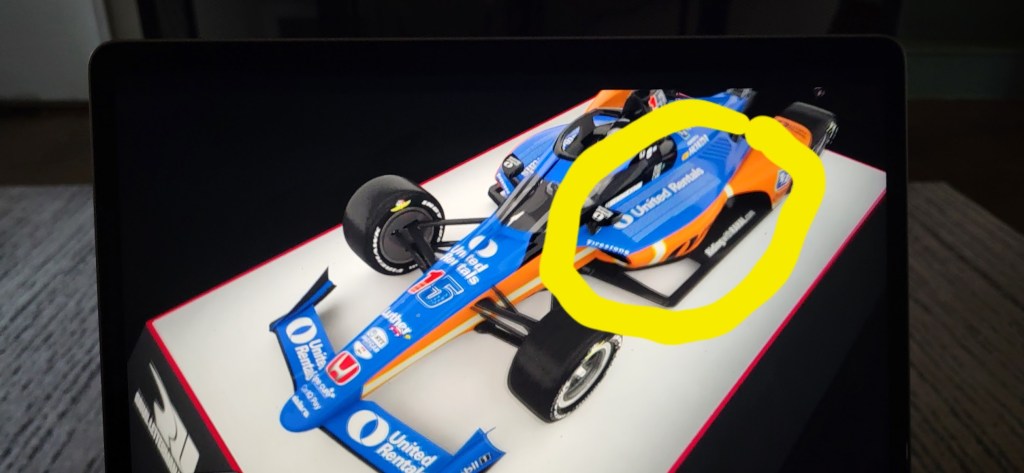
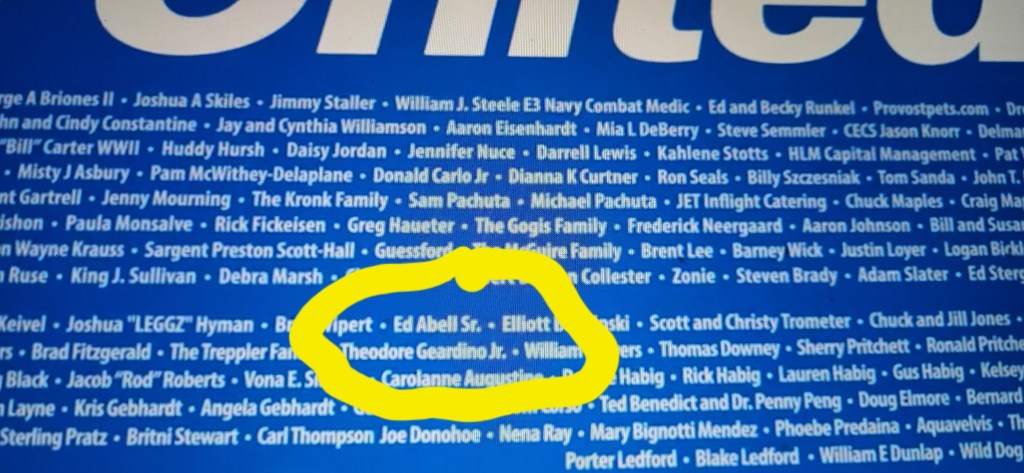
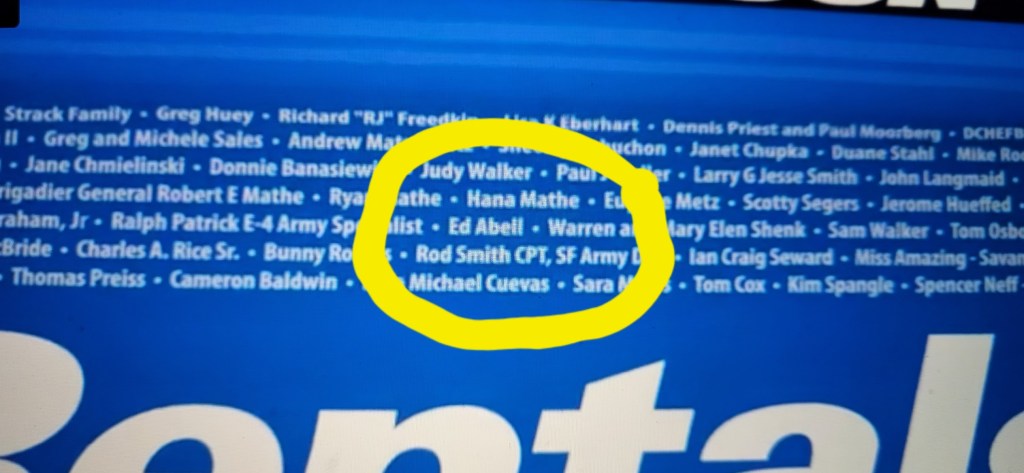
Through the Graham Rahal/Britney Force Foundation supporting Turns for Veterans, I discovered I could get both our names, along with many others, printed on the side pods of Grahams #15 United Rentals race car he will drive in the Indy 500.
Yesterday, I received a video flyby of Grahams car and could pause and find our names.
I’d be glued to the tube for the race regardless, but this year will hold special emotions and memories while viewing the Greatest Spectacle in Racing.
And, wherever my father is, he’ll be flashing his gap-toothed grin and eating a hotdog.
Visiting my sons and their significants by automobile requires a thousand-mile journey either east or west from Wisco to North Carolina or Colorado. We drive because we usually stay for a month or so. Plus, flying is a grind and we can take all the stuff we need and more.
Recently, our journey west included a new route out of Lincoln, NE to Denver. Instead of bolting down HWY 80 we dropped down to HWY 34 across Nebraska. This lesser used two-lane highway traces the Oregon Trail and lets you experience the infinity of the western plains. Passing through towns like: Holdrege, Arapahoe, McCook and Wray.
Historical markers tell the tale of wagon trains and buffalo herd massacres. The horizon spotted with silver grain elevators and massive cattle feed lots that you hope are down wind.
Entering Colorado, we regained HWY 76 and began the long uphill run to the mile-high city. Signs warned us of high crosswinds as we entered a world of massive billowing dust clouds and armies of tumbleweeds propelled by 25 mph winds and punchy gusts.
Traffic ran at 80 mph. Our two bicycles on the rear rack acted like a wagging tail. Hundreds of tumbleweeds summersaulted across our path in migratory clouds each with it’s own personality. Large and small, oblong and round, our roadway was alive. Only when civilization began to appear did the tumbling crowds subside.
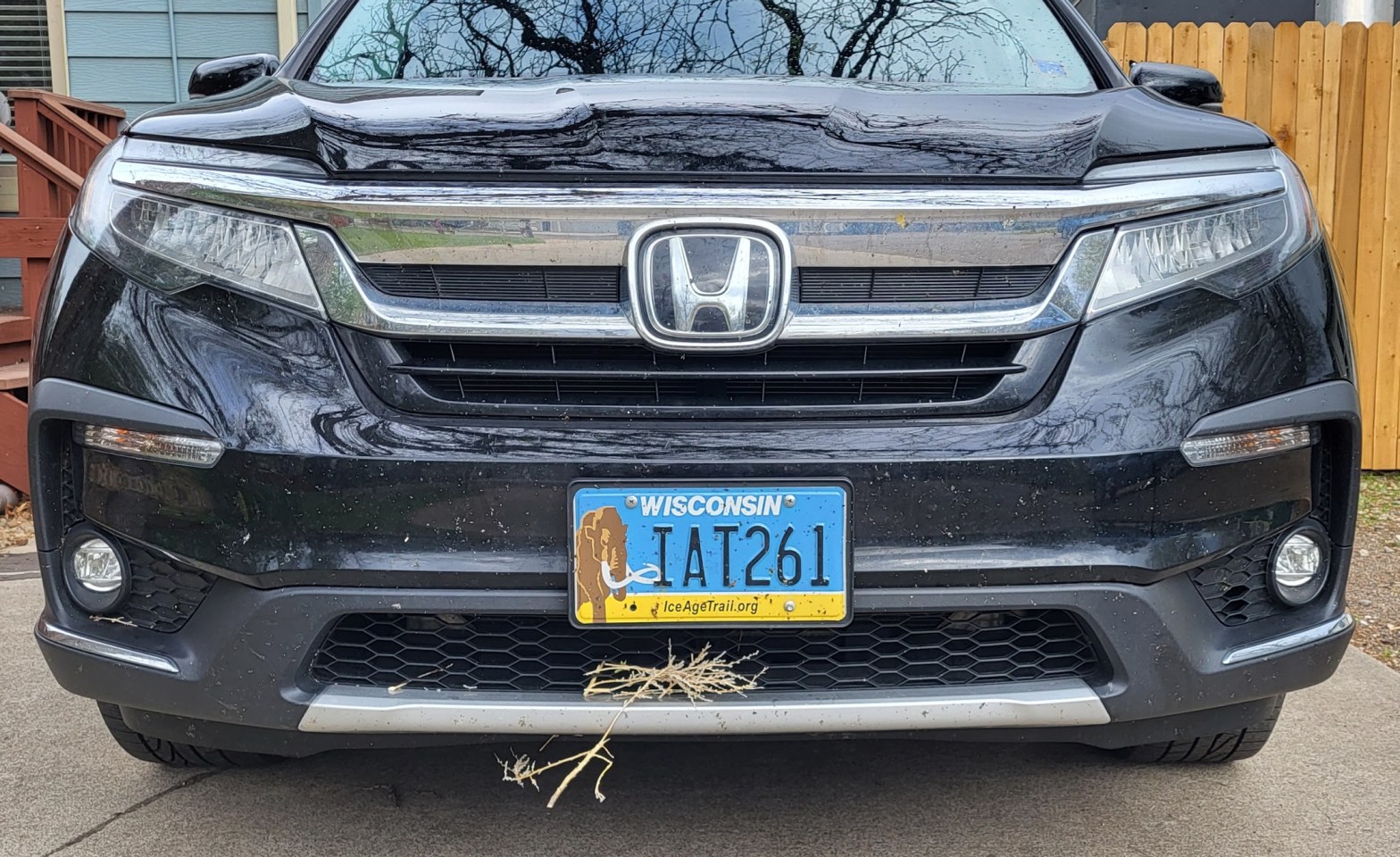
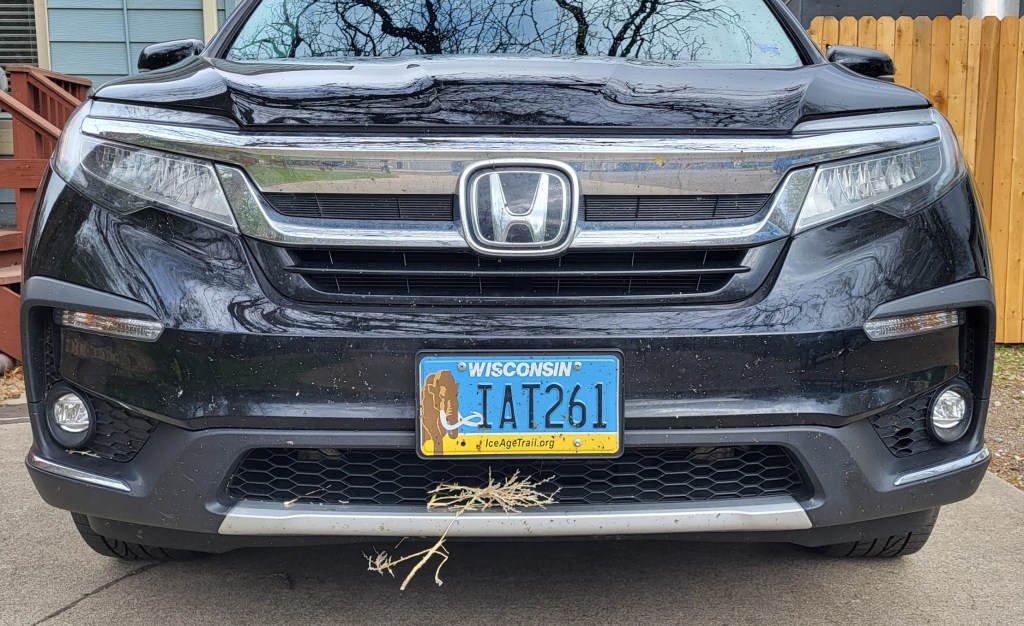
While unpacking the car we noticed a small tumbleweed we caught mid-stride in the grill. For anyone else it’s simply trash, for us, a remembrance of life and the wonder of crossing the open plains.
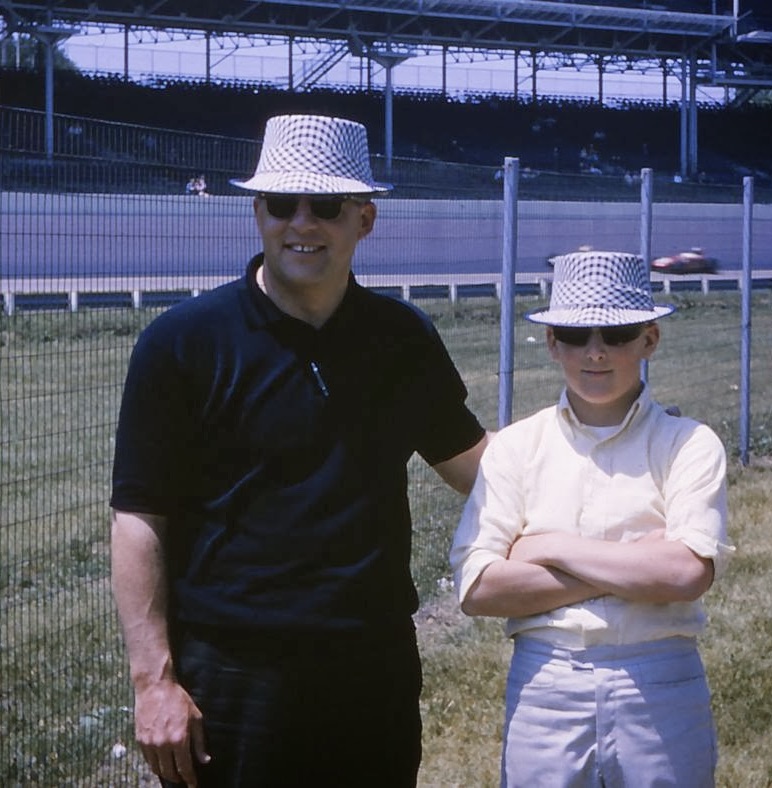
My father with his ever present pen and I in corner one at INDY
My father took me on a business trip to Indianapolis when I was twelve-years-old. He sold investment casting products for a foundry in Milwaukee called Sivyer Steel. Every May during practice for the Indy 500, he would plan a trip down to see the massive, front-engine Roadsters pound around the 2.5-mile oval and entertain his clients. In 1963, in addition to the bellowing sounds and speed of the traditional roadsters, it would also be my introduction to the petite, hi-pitched, rear-engine cars like the International Racing Series, (F1). Humming Birds among the roaring Lions.
In those days, he could drop me at the track at 11:00 am, give me five dollars for the day, and say he’ll meet me at the hotdog stand in corner one at 4:00pm. In today’s culture, that’s child neglect and half a hotdog, maybe.
Dad also had me look nice for meeting his clients. I felt like a dork, but his lessens to dress appropriately would serve me well in my life.
I was curious about those little cars and because it was practice, the crowd was small and I could sit anywhere. From the program, I learned the two drivers were Jim Clark and Dan Gurney, a Scotsman and an American. Clark sat on the pit wall in a one-layer beige driver’s suit void of the advertising billboards we see now and soft black leather shoes for driving. He looked like an English teacher amongst the burly, he-man, vibe of the American drivers like: AJ Foyt, Parnelli Jones and Jim Hurtubise. To me, he was an everyman and in the new-fangled, read-engine car, he was as fast or faster than the roadsters.
Jim Clark (L) and Dan Gurney
Clark would finish second at Indy in 1963. The following race at the Milwaukee Mile was the following weekend. Sitting with my dad, we watched Clark lead every lap and pass every car except AJ Foyt out of respect, for the win. Jim Clark would become one of my heroes and I became a F1 fan.
To follow F1 back then, my only avenue was the Road & Track magazine my dad received once a month. I learned about the famous circuits around the world like: Monaco, Monza, and Spa, and followed my hero’s exploits to two world championships and victory in the 1965 Indianapolis 500. The first win for a rear engine car at Indy that would change the paradigm and doom the front engine roasters.
Clark was killed racing in 1968. His peers considered him the best among them. His car control was above the rest and he never made mistakes. In the aftermath, the investigation would discover it was a tire failure, not driver error. When I heard the news on the radio, I cried. So goes the power of our heroes.
I remained an F1 fan. I saw my first F1 race in Mosport, Canada in 1974 followed by twenty-five live F1 races around the US and Canada. Both my wife and two sons have been to races.
Fast forward to 2024. F1 and all forms of racing are now part of the global entertainment business and I continue to foster my heroes. All the F1 races are broadcast on TV and streaming services. Viewers and subscribers can view all the weekend activities: three practice sessions, qualifying, and the race.
Now days, I can sit in my TV room with the big screen and watch several days of activities: three practice sessions, qualifying, and the race. During the races, I also stream the F1TV app on my laptop and see driver in-car cameras and lap time charts. Heck, I can even watch live F1 coverage on my phone now.
And yeah, eating a hotdog, especially at a race track, still awakens the twelve-year-old.
Kristin and I conjured a trip to Puerto Rico for our birthdays this year. Considering our phones would work, the money is the same, Wisco is 7 degrees, and we’d never been there, it was an easy and exciting choice.
Research told us the people of Puerto Rico were kind, curious, and happy. I can say that every person we’ve encountered has been all those and mindfulness abounds. From making my Pina colada (Invented here) with the rum on the side so Kristin can have a double, to changing the TV channel at the bar to the Packer/Eagles game on the big screen.
We are in Old San Juan to begin our jaunt around the entire island. A city that reminds me of the French Quarter in New Orleans, filled with history founded by the Fountain of Youth guy, Juan Ponce de Leon in 1508.
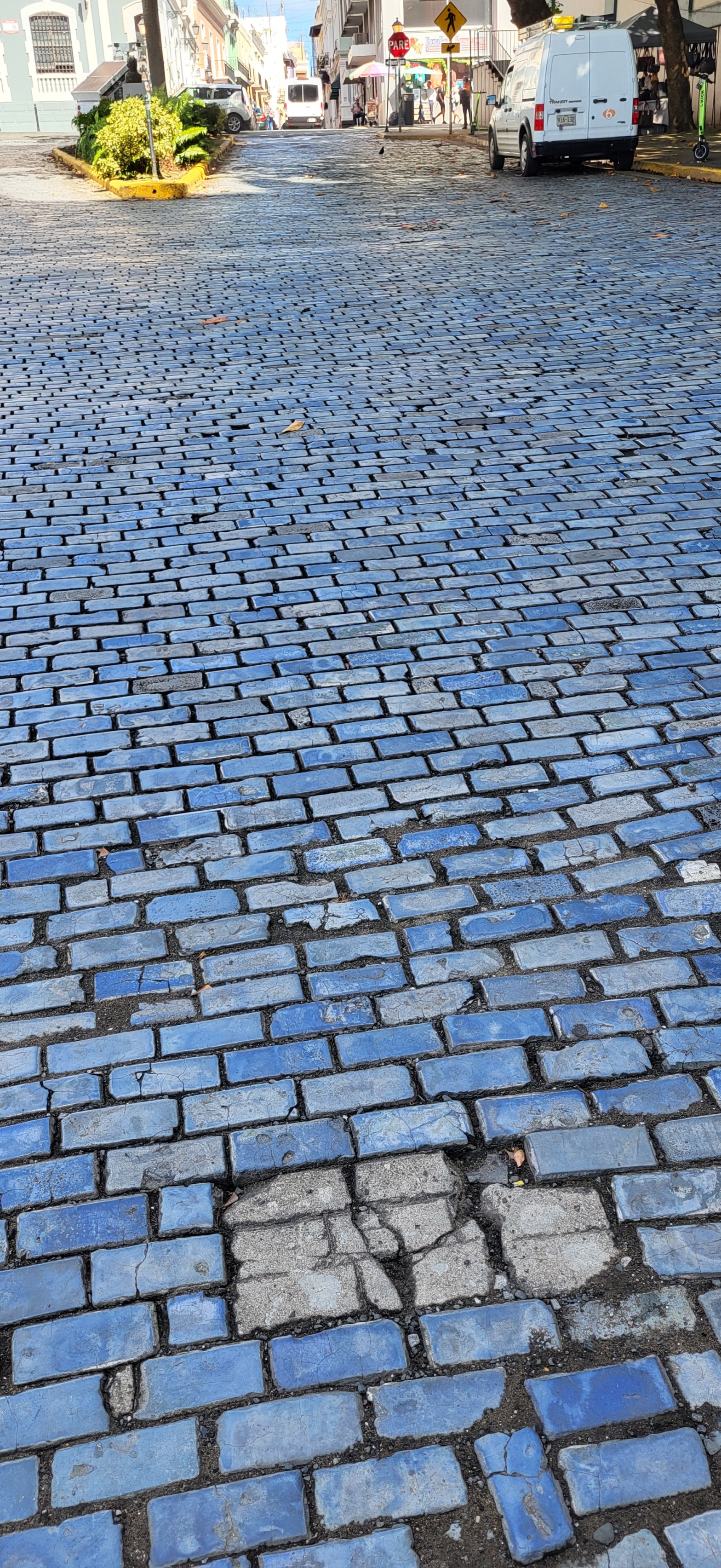
We are trekkers, so our explorations are all done on foot. As we strolled, I found it impossible not to notice all the streets are paved with blue cobblestones called adoquines. Like I said, the phones work so Google told us that the stones are actually ballast from European ships in the 18th century. The ballast stones were originally made using the waste from iron smelting.
For the streets of Old San Juan, the third times a charm.
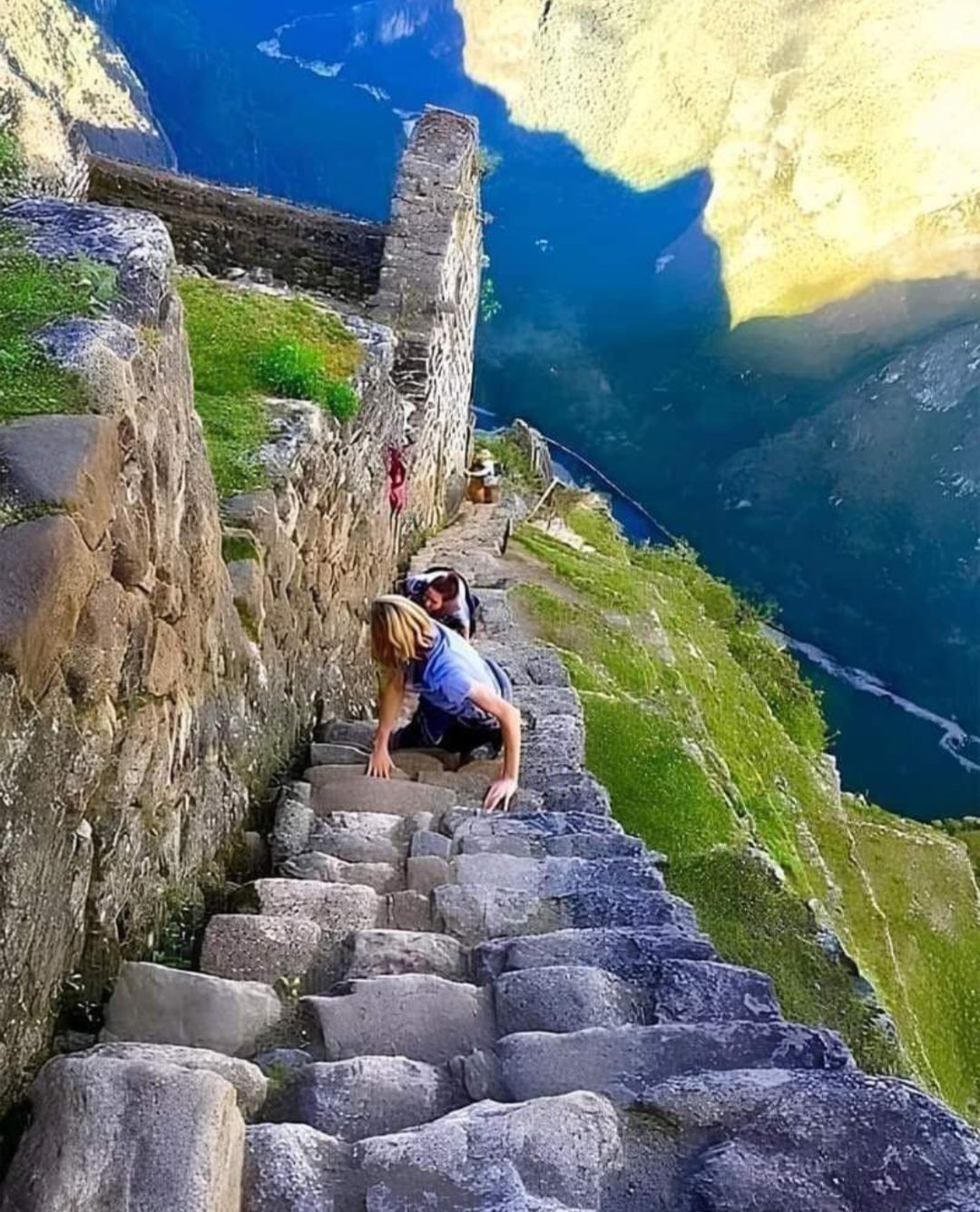
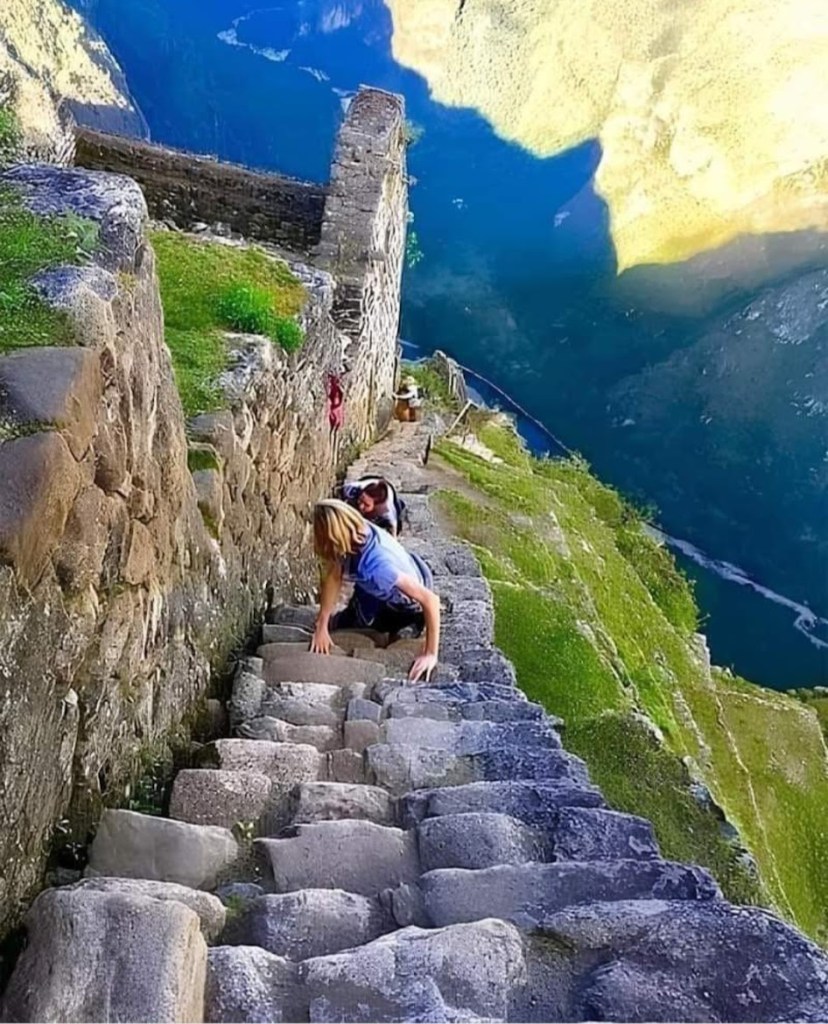
Yes, I’d seen the YouTube videos of the 60-degree stone steps. On one side a wall or a cable to grasp occasionally, on the other, a 2000-foot drop into oblivion. My experiences climbing the Western Breach of Mt. Kilimanjaro and the trek to Mt. Everest Base Camp had taught me that height exposure could be turned into exhilaration as long as the footing is not precarious.
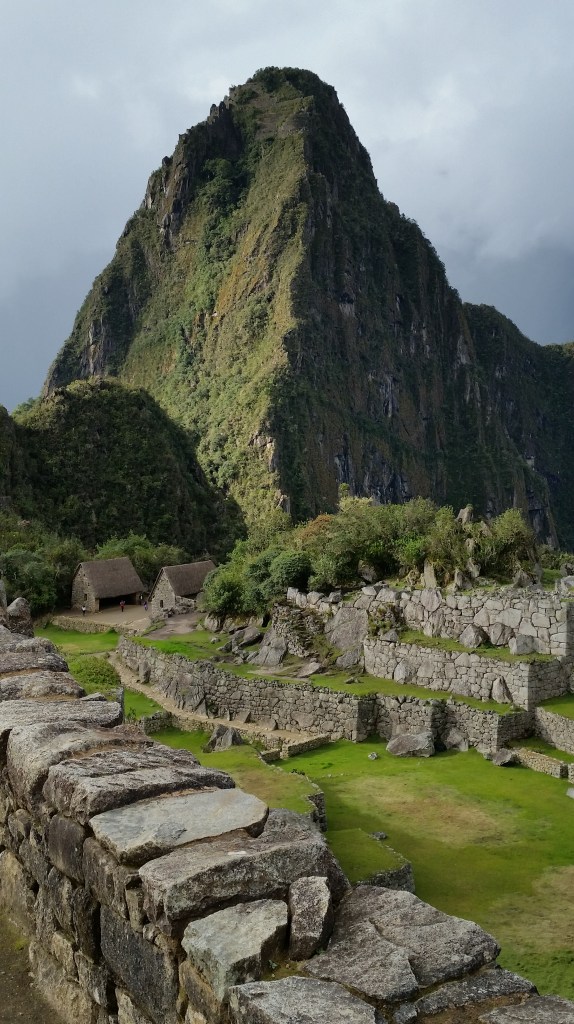
Hauyna Picchu standing over Machu Picchu
My wife, Kristin and I were planning a Peruvian Tour with Overseas Adventure Travel (OAT). In addition to other beautiful locations, our group was going to tour Machu Picchu in an afternoon, spend the night in the nearby town of Aguas Calientes, and then return the following morning for optional hiking. The group was going to do the traverse to the Sun Gate, but I had made my own plans.
Early in our research, I had discovered the Huayna Picchu hike. Our optional day provided an opportunity to acquire the necessary advanced ticket and time slot for Huayna Picchu. All of which had to be done prior to leaving Wisconsin. It looked fun and quite manageable to me. I had to email a photograph of my passport with the online application along with around $90 US. And lastly, upon arrival in Peru, I had to email a picture of the entrance stamp in my passport.
Kristin had climbed Mt. Fuji with our two son’s and I, she had the legs, but the extreme exposure was out of her comfort zone. On our first afternoon strolling around Machu Picchu, we stood with Huayna Picchu towering over us and I told her I’d signed up to climb The Stairs of Death the next day.
Bless her heart and her understanding, Kristin joined me for breakfast at 5am and walked with me to the first bus to the main gate at 5:30am.
The pre-dawn ride up the countless switchbacks was filled with the predictable feelings of self-doubt, anticipation, and excitement. I crossed the entire Machu Picchu grounds to reach the gate to Huayna Picchu with twenty minutes to spare before my 7am start time. The site rules allow 200 people in between 7 and 8am and 200 between 11am and 12 noon to enter each day. I was alone most of the time.
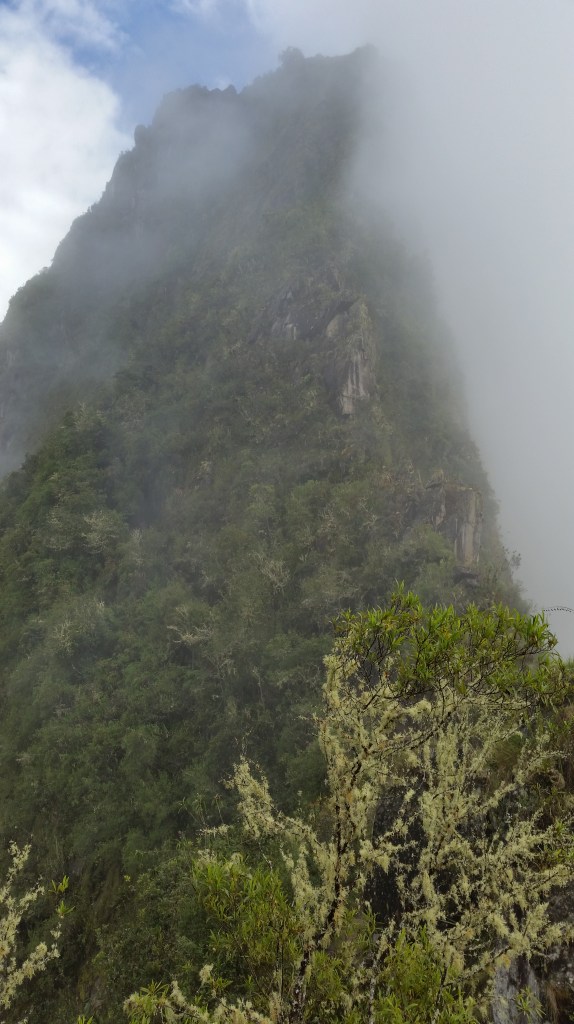
Huayna Picchu was offering me an additional challenge. The mountain was draped in a mysterious opaque fog, but the rain had stopped hours ago. The steps would be wet, but I’d be moving slowly at altitude. I saw no reason to retreat.
I was number eight through the gate for my trek into the clouds. As I ascended, it was obvious I would not be able to see how far I could fall, but make no mistake; I could feel what the quiet gray mist hid. Regardless, I would see the exposure on the way down. The task became straightforward, take every step one at a time and keep my balance.
As the first photograph shows, most of the steps are three feet wide and provide solid footing. Wouldn’t you know, visiting this far away exotic destination, the first person I encountered resting along the trail was from Madison, Wisconsin.
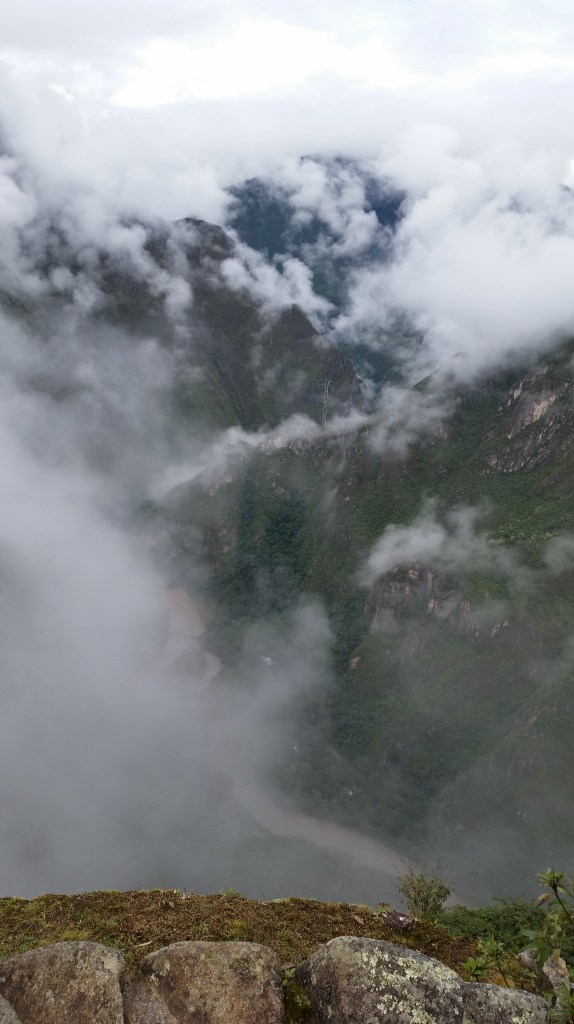
My summit view with the Urubamba River far below
My pace felt good up the serpentine trail and I was on top in one hour along with a dozen other souls. The fog was dissipating, so I simply worked my way carefully down the well-marked trail. Passing ascenders on the steps took consideration as the exposure was now obvious. Down-climbing is more difficult because if you stumble on the way up you can grab the steps or the wall. All you have on the descent is a hand on the wall, the Peruvian sky, and what mountaineers call the grand tour to the bottom of the valley.
Returning to the gate, I clocked out at 9am ready to meet Kristin at the Machu Picchu gift shop. A quick glance at the log told me, on this day, at sixty-six, I was the oldest climber by twenty years. It was an exhilerating experience. I felt pretty darn good.








 The Adventures of Spaghetti Eddie