Early in our lives, my father bestowed some classic Baby Boomer life lessons on me and my two brothers: look the person you’re greeting in the eyes, offer a firm handshake, be polite, and dress appropriately. This was a time, in the fifties and sixties, when personal relationships and appearance were held in high regard as tools for success.
In 1972 near the completion of the school year, four junior industrial design students, our entire class, were called into a meeting with the President of Layton School of Art, Edmund Lewandowski. I’d never accually met Mr. Lewandowski, but I recall walking passed the open door to his office and seeing him sitting straight up at his immaculate desk. His pipe, chair, pen set and papers all at right angles to each other. Content from the meeting escapes me other than chit-chat. My fellow juniors looked like art school students, dirty jeans, sweatshirts and PF Flyers; all of us looked like that most of the time. But for this particular meeting with the school President, the echo of my father’s teachings prevailed, I showed up wearing a clean shirt and tie. It just seemed like the correct order of business. I didn’t know I was competing for anything, but how I carried myself in that meeting, and my gesture of propriety, would launch an incredible opportunity. A gift from the ether that, point-blank, set the trajectory for my life.
My mother came into the room at 8:30 am. I was working the third-shift, I’d only been in bed for an hour. “Eddie someone from the Layton School of Art is on the phone, he said it’s important.” My first thought, of course, was what have I done? It was June. I’d finished my junior year studying Industrial Design and was working over the summer as always. I picked up the phone and said, “Hello.” It was the school administrator, “Good morning Ed this is Kempert Quabius. Layton has been chosen to be one of thirteen design schools across the nation to represent American design schools at the 1973 International Congress for the Society of Industrial Design (ICSID) gathering in Kyoto, Japan. It’s a three-month culture exchange tour. You’ll travel around the three main islands visiting: industries, schools, and historical sites. The four-day ICSID event is roughly in the middle of the journey. The Edger Kaufmann Foundation will pay for: flights, room and board, plus the fees for the conference. You only need spending money. Would you like to represent us?”
I’d rarely been out of Wisconsin. I couldn’t speak or read Japanese. I wouldn’t look like everybody else. I couldn’t use chop sticks. I didn’t know any of the customs and the currency was an unknown. I was twenty-two-years-old, where do I even get a passport? My head exploded.
My mother looked like space aliens were kidnapping me. Of course, I said, “Yes.”
It was a grand adventure. I’d never been an outsider, a minority, or been somewhere with no points of reference. That new perspective impressed me; I vowed to bring my children to Japan (if I ever had any) for the same experience. For me, being the foreigner broadened my worldview. It made me curious about understanding new things and people. That is to say, I tried all the food, learned enough of the language to be polite, and dared to go out dressed in classic Japanese robes. I left Japan with a robust sense of wonder, open to what the world had to offer.
Describing it all would take many pages. For this missive, I will offer one specific highlight.
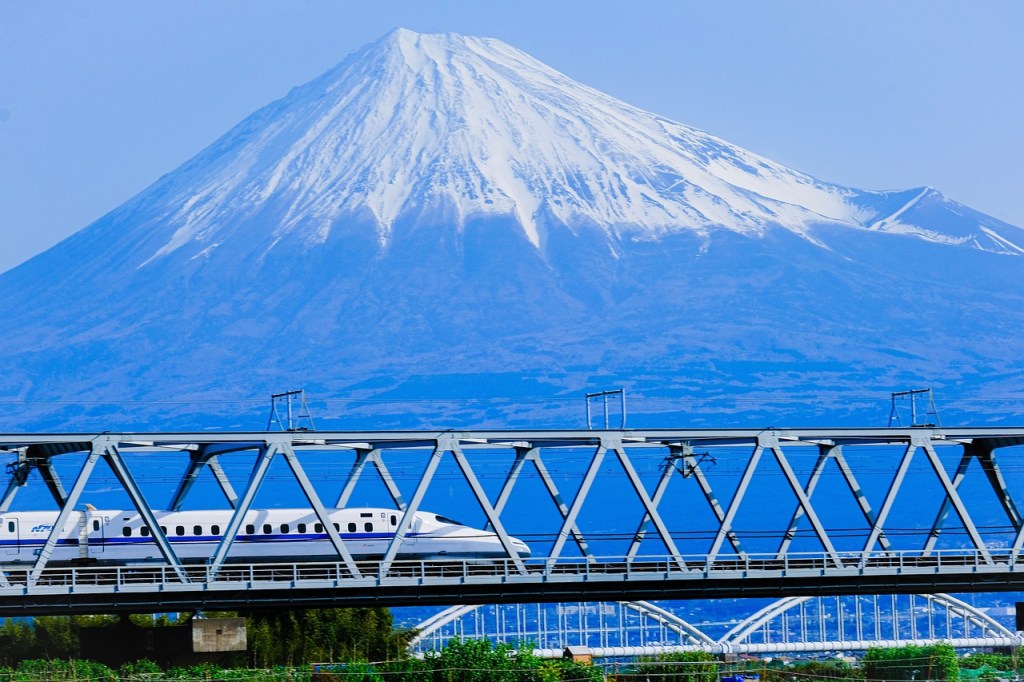
We were on the Shinkansen (Bullet train) rocketing across the southern plains at 180 miles per hour towards our departure city of Tokyo. The many tunnels we passed through created a strobe-light effect. You’d alternate between seeing your reflection in the black of the window and the sun-lit landscape. Suddenly, she appeared through the window standing in regal indifference, her snow-capped shoulders draped in cerulean blue, my first iconic mountain, known throughout the world, the highest in Japan, Mt Fuji. She took my breath away, Fujisan was enchanting, inviting, mysterious, sensual.Her contour was unmistakable, a perfect cone, the summit dazzling, crisp, white. She was like the girl you have a crush on walking into the room: mysterious, alluring and perhaps unattainable. As I stared, I felt like she had something for me. In my heart I said with complete faith, someday I’ll return for your gift, and then darkness. The entire encounter was over in fifteen seconds, but Fujisan had vexed me. That was the moment the subliminal seed was planted. At the time, I didn’t realize how much I’d been smitten, but this encounter would unleash the power of positive affirmation and creative visualization.
The arc from that first view in 73’ to my return to Japan to climb Mt. Fuji with my family took twenty-eight years. Life happened in between: Graduation, a design career, finding a mate, having children, owning a home, and saving for travel. But, once the power of visualization is set in motion, one must be patient, make yourself available, and be open to the signals that point to your dreams. Japan would be the first of several mountain ascent for my family, the immersion in a new culture for my sons, and an unforeseen friend would materialize to assist us. Her kindness enabled our success on Mt. Fuji and her dream, that she shared with us on the summit, would lead all of us to another spectacular adventure in front of 250,000 lining the parade route.
All because I’d worn a tie.


Well done! Great story.
LikeLike